Category Archives: Uncategorized

Namibian dairy industry in fight for survival

The Namibian dairy sector is battling to survive, with production decreasing and the price-cost squeeze forcing producers to exit the sector.

According to Kokkie Adriaanse, chairperson of the Namibia Dairy Producers’ Association, raw milk production dropped from 21,8 million litres in 2019 to 17,2 million litres currently, which was a 21,1% decline in volumes.

The organisation and various other role players, including milk buyers and trade specialists, had therefore petitioned the Namibian government to introduce a subsidy on animal feed. However, a decision on the matter was still awaited.

Roelie Venter, CEO of the Namibia Agricultural Union, told Farmer’s Weekly that the role players had requested a R2/ℓ subsidy on raw milk.

He said the local milk production sector was facing an uphill battle. The majority of animal feed in Namibia was being imported from South Africa, with transport costs constituting about 20% of the cost, pushing production prices sky-high.

“This erodes our local producers’ competitiveness and makes it virtually impossible to compete with imported milk. Milk loaded in Cape Town and delivered in our capital Windhoek can be sold for less than locally produced milk. Should the state decide to [introduce a subsidy], it will go a long way to get the industry up and going again.”

The drought that had been experienced during the past few years had also resulted in low water levels in local dams, and a significant decline in fodder production in the Hardap Dam area, where close to 80% of the country’s raw milk was being produced.

Adriaanse added that some dairy producers were consequently forced out of the milk production industry, and that had contributed to drastically reduced volumes of raw milk being produced in Namibia.

Since the early 2000s, the number of milk producers in Namibia declined from 45 to 10.

In addition, despite the country’s milk production cost index indicating that total expenses increased 10,4% year-on-year, no significant change had been evident in the raw milk price.

In addition, the recent heavy rainfall recorded across the region resulted in fodder being harvested late, while the quality of the fodder had also declined, Adriaanse said.

“Producers are now faced with the challenge of acquiring additional inputs to improve the quality of feed, adding to an increase in feed costs. Government support over the next two years is vital to get the industry going again.”

Good weather aids SA’s 2020/2021 table grape crop

Intake volumes for South African table grapes are expected to increase to between 65,3 million and 69,8 million 4,5kg-equivalent cartons, according to the South African Table Grape Industry’s (SATI) third crop estimate for the 2020/2021 season, released on Wednesday, 3 February.

Willem Bestbier, CEO of SATI, said the positive outlook was due to very good weather conditions, sufficient water availability after last winter’s rainfall, large berry size, and the overall good quality of grapes.

READ Wine farmers go to court in a bid to overturn liquor ban

“The Orange River region is concluding its season, and the two-week delay at the start of the season and the rainfall at the beginning of the year have had less of an impact on the later cultivars than initially expected.”

The 2019/2020 season ended on 66,15 million 4,5kg cartons. This season’s increased estimate with regard to volumes was due to very good quality and harvesting conditions in the northern provinces of South Africa, as well as the three Western Cape-based production regions.

Bestbier said the Chinese market presented a very significant opportunity for South African table grapes, with an annual export potential of between 3,5 million and 4,5 million cartons.

He added, however, that this year would be difficult as the market seemed to be quite volatile as a result of the COVID-19 pandemic.

READ Sugar cane speedlings: the fast-track solution to quality seed cane

“About 75% of our exports will continue to go to Europe and the UK; the rest is evenly spread [across] the rest [of the international market], which includes Southeast Asia, the Far East, Middle East, US, and Canada.”

It was expected that there would be greater demand from the local market this year.

“Quality products [are becoming] increasingly available on local supermarket shelves, and there is a drive towards [healthier] diets, which includes fresh fruit.”

Bestbier added that the general demand for South African table grapes was steadily increasing, with the production base growing about 4% per annum over the past five years. However, the export market was very dependent on the weather during the packing season.

Anton Viljoen Jr, a table grape producer in the Hex River region and SATI chairperson, said: “The demand for pre-packed grapes in plastic punnets has picked up, which has created some delays in packing.”

He added that the Olifants River region had had a good harvest so far, and had started to recover from the drought conditions experienced in the region over the past five years.

Making lucerne hay while maximising soil health

It is a dry, late winter’s day on a farm in the Glen area, north of Bloemfontein, where a plume of dust trails the tractor carrying Freek Strauss as he plants a 30ha, pivot-irrigated lucerne land.

Strauss is primarily a lucerne producer who works the lands for his employer, local farmer Dirk Botha.

Although the production of lucerne hay is the main business of the farm, the crop is also used for another important purpose: to improve soil health.

Lucerne, like other legumes such as soya bean, lentils and clover, fixes nitrogen in the soil; Strauss therefore plants it in rotation with field crops such as wheat and maize to increase their yield and quality.

Lucerne farmer Freek Strauss (left) with his son, Joshua.

Lucerne as feed
Lucerne’s feed properties have earned it the title ‘king of hays’ and demand for it is high in several livestock sectors, particularly dairy. It can serve as both a grazing crop and as hay.

Strauss’s main focus is the production of prime-grade lucerne hay, baled in large packs and sold by the ton via both local and export channels, depending on which presents the best opportunity for a specific grade at any given time.

The National Lucerne Trust (NLT) is the representative body of the South African lucerne seed and hay industry. Amongst various services, the trust oversees the grading system for lucerne hay, the quality standards of which are set out in its New Lucerne Quality Index (NLQI), introduced in 2015.

The NLQI covers four grades, namely prime, first, second and third. Certification is based on samples tested for moisture content, protein, starch and sugar percentages, lignin content, the presence of mould, foreign matter or noxious plants, and other parameters.

The best cultivar
Strauss strives to produce a crop with the maximum yield per hectare, as well as a quality profile or grade that will earn the greatest profit. A well-established lucerne land can deliver a regular cash crop for three-quarters of the year for several consecutive years.

He emphasises that there are numerous factors to consider when planning to establish a lucerne land. Foremost among these is selecting the optimal cultivar and/or seed for commercial hay production. For this, he has partnered with seed company Barenbrug South Africa.

According to Strauss’s adviser from Barenbrug, Wicus Jordaan, the company’s lucerne package comprises cultivars developed through research by the South Australian Research and Development Institute over many years.

Its Barenbrug Australia seed range is available in South Africa and offers farmers different options in terms of dormancy, yield and longevity.

The seed varieties are described as being well adapted to perform in most climates and under dryland and irrigation conditions.

Strauss has planted the BAR 7 winter active variety for a number of years.

This has a dormancy level of seven and is well adapted for both hay production and grazing in summer rainfall areas. It can be planted on dryland in areas receiving at least 350mm/ year, and thrives as an irrigation crop.

He has also been growing the newer BAR 10 high winter activity cultivar Groengoud (green gold).

According to Barenbrug, BAR 10 is the next generation of the old SARDI 10 and has been bred for maximum winter production and persistence.

Strauss uses both cultivars in his rotation strategy depending on where he is planting; BAR 10 requires more water and is therefore established on lands with access to better water supply.

He emphasises the importance of selecting a variety that is suitable for a specific area, and taking into account dormancy levels, whether the farm is in a winter or summer rainfall area, and how thirsty the cultivar is, among other factors.

According to the NLT, lucerne cultivars vary from highly dormant to extremely non-dormant, and breeders classify them on a scale of 1 to 9, with 1 being highly dormant (adapted to very cold areas) and 9 being extremely non-dormant (adapted to warm, favourable conditions).

Getting it right
A land that Strauss plants in June/July produces its first cut in spring or early summer. As the crop must produce optimally for several years, field preparation and planting need to be carried out with care. Strauss therefore takes soil samples before planting to enable him to make fact-based decisions on any soil corrections that may be necessary.

“With lucerne, it’s important to make sure that calcium and sodium are in the correct ratio,” he says.

He also fertilises with chicken manure and uses a 2:3:2 nitrogen, phosphorus and potassium fertiliser. As his soils have a high clay content, he adds gypsum to prevent compaction.

Strauss keeps his tillage to a minimum to prevent damaging the physical structure of the soil; he carries out only a shallow rip and creates a fine, level seedbed.

Before planting, Strauss inoculates his seed with Rhizobium bacteria to ensure fixation, which can result in an increase in yield. He then plants with a tractor-drawn fine-seed planter that he has modified slightly to his preferences. Irrigation follows as soon as possible after planting.

After the crop has matured, Strauss aims to cut hay every 28 days. Although the rule of thumb is to cut at the 10% flowering stage, Strauss prefers to base his decision on regrowth.

“I don’t want to damage the plant by cutting too early, so I try to cut when the regrowth is 3cm to 4cm,” he says. “After we cut the lucerne, it needs to be raked and must dry properly (around 16% moisture content) before we bale it.”

Every year present its own challenges.

The Bloemfontein region has grappled with drought in recent years, for example, and extreme heatwaves require precision irrigation management. Strauss relies on technology to optimise water use.

“We use moisture meters to ensure that we irrigate sufficiently, but don’t add too much when it’s raining. We don’t want to drown the lucerne,” he says.

Maximising yield
A productive lucerne land will continue generating a regular cash crop that can be harvested through spring, summer and autumn. The land can also continue producing for about five years, or even up to 10 in some cases. But commercial producers are likely to replant more regularly to ensure maximum yield and volumes, as well as quantifiable feed values.

For Strauss, this means rotating with another crop every three or four years. Herein lies the second element of his strategy: the value that the lucerne crop adds to the soil.

Lucerne is generally viewed as drought-hardy, as it has an aggressive taproot system growing down to 2m that can store moisture and nutrients. As mentioned, it also binds high levels of nitrogen to the soil, improving the structure of the soil.

This means that his lucerne not only provides a consistent income stream, but helps ensure that other crops planted in rotation benefit from the improved soil and produce better yields.

At the time of Farmer’s Weekly’s visit, Strauss had just cut a lucerne land for the last time after four years of continuous production, and was preparing it to be planted to its first rotation crop of wheat.

“I’ll also plant a teff crop in December or January before replanting lucerne again next year,” he says.

Email Freek Strauss at freekstrauss@gmail.com. Email Wicus Jordaan, technical marketer at Barenbrug, at wjordaan@barenbrugsa.co.za.

Sharp drop in rhino poaching due to lockdown travel bans

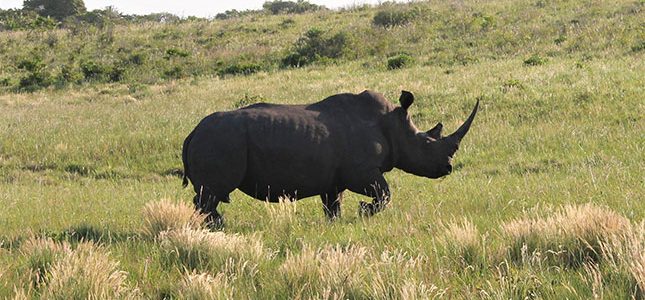
Despite facing similar threats to their animals from poachers than their government counterparts, South Africa’s private white and black rhino owners have been able to do a good job of protecting and even growing the country’s populations of these endangered species.

This was according to Pelham Jones, chairperson of the Private Rhino Owners’ Association (PROA), who said that a survey found that as at 31 December 2020, the country’s privately owned white rhinos numbered over 8 000, and privately owned black rhinos 450. This amounted to over 50% of South Africa’s total rhino population.

READ Farmers say ‘not worth their while’ to report stock theft

“Of the 594 rhinos poached nationally in 2019, only 15% were in private reserves. The rest were in the Kruger National Park (KNP), other national parks, and in provincial parks. The private sector gets no funding to protect its rhino, but the national and provincial parks get funding from government, and from international and national donors,” Jones told Farmer’s Weekly.

“South Africa’s private rhino owners are dealing with the same onslaught from poachers, but have had to keep paying for protection for their rhinos despite not being able to generate income from international tourism and hunting because of the COVID-19 travel restrictions, and a severe decline in game sales. They are losing billions of rand. Our private rhino owners are unsung heroes; getting no recognition from government,” he added.

On Monday, 1 February, the Department of Environment, Forestry and Fisheries (DEFF) released information indicating that South Africa lost 394 rhinos to poachers in 2020. This was, according to DEFF spokesperson, Albi Modise, 33% fewer than the 594 rhinos poached in 2019, and the sixth consecutive year that rhino poaching in the country had continued to decrease.

“During the COVID-19 hard lockdown period, we had a significant reduction in poacher incursions into the KNP. However, that changed later in the year as the lockdown levels eased, and a significant spike in poaching in the KNP was experienced towards the end of 2020, especially during December,” he said.

DEFF’s information showed that, in 2020, 245 rhinos were poached in the KNP, and two in the Marakele National Park.

READ Is rhino breeding a potential gold mine for cattle farmers?

The Minister of Environment, Forestry and Fisheries, Barbara Creecy, said: “While the extraordinary circumstances surrounding the battle to beat the COVID-19 pandemic contributed in part to the decrease in rhino poaching in 2020, the role of rangers and security personnel who remained at their posts, and the additional steps taken by government to effectively deal with these and related offences, also played a significant role.”

Modise said to move from the “current moderate win to a strong win” with regard to reductions in annual rhino poaching statistics, government was focussing on a more proactive and integrated approach. This would build on existing initiatives and also “blur the distinction” between national, provincial and private parks when it came to collaborative efforts to protect their rhino populations”.

In addition, according to Modise, South Africa’s law and environmental authorities had increasingly collaborated to more effectively apprehend and prosecute rhino poachers.

“Countries working together in sharing of information and investigations to combat wildlife trafficking remains a key to […] success […], even in this difficult time of COVID-19,” he said.

Expropriation bill ‘will limit property rights’ in SA

Free State Agriculture (FSA) remains vehemently opposed to certain clauses in the Expropriation Bill and seriously questions government’s sincerity with regard to the issue of land expropriation and ownership, according to Francois Wilken, FSA president.

Following the recent publication of government’s land policy, he said the new Expropriation Bill posed a real threat to all South Africans’ rights to own property.

“It is important to understand that the stated aims of the new Expropriation Bill are to allow the state to target and expropriate any property without compensation. In other words, through this legislation, government does not seek to expand property rights, it seeks to limit it.”

According to Wilken, government did not need the Expropriation Bill in its current format to expand the base of private land ownership in South Africa.

If broad land ownership was a priority for government, it needed to start a process of transferring the ownership of the 5 300 state-owned farms to previously disadvantaged individual beneficiaries, he said.

Wilken said the Expropriation Bill would not address these challenges, it would merely destroy the rights of the rightful landowners, and the livelihoods of farmworkers and rural communities in general.

FSA was therefore preparing a full report to serve as the organisation’s response to governments call for comments on the Expropriation Bill.

“FSA believes that property rights should be expanded to all South Africans. The Expropriation Bill will limit, if not destroy, this right that’s central to job creation and economic growth,” Wilken stressed.

Dr John Purchase, CEO of Agbiz, meanwhile said he did not know of any instance elsewhere in the world where expropriation without compensation was successfully implemented, and quoted Zimbabwe, Venezuela and Nazi Germany as examples where it led to large-scale ruin.

Although expropriation legislation was vital for any country, the lack of compensation as proposed in South Africa was extremely problematic.

However, the existing legislation was extremely outdated and did not adhere to the requirements of the Constitution. It allowed the state much more power than the proposed Expropriation Bill, and contained far fewer procedural checks and balances, he said.

“We do need an updated legal framework for the issue of expropriation, but we cannot and will not support any legislation that calls for expropriation without compensation. South Africa simply can’t afford it.”

Written input from members of the public on the Expropriation Bill can be submitted until 10 February.

FSA consequently urged all concerned citizens to “make their voices heard against the Bill”. FSA created a portal on its website where the public can register their opposition: vrystaatlandbou.co.za.

How agriculture can limit Earth’s shocking biodiversity loss – WWF report

Global economic growth over the past half-century has changed our world unrecognisably, driving exponential improvements in health, knowledge and standards of living.

Yet this has come at a huge cost to nature and the stability of Earth’s operating systems that sustain us.

Since 1970, global GDP has increased four times, the extraction of living materials from nature has tripled and the world’s human population has doubled, along with an enormous trend towards urbanisation. People living in cities now account for 50% of the global population.

Trade has exploded; the value of exports rose 200-fold from 1970 to 2017, with the largest increases in developed countries.

This boom has enabled higher-income countries to increase their consumption even though nature, within their own boundaries, is relatively well protected; much of the added consumption is from nature’s contributions imported from lower-income countries, and these contributions are sometimes surrendered for little economic growth.

The cost of the growth
The biodiversity cost of the world’s expanding population and economic output has been significant.

Since the industrial revolution, human activities have increasingly destroyed and degraded forests, grasslands, wetlands and other important ecosystems, threatening human well-being. Seventy-five percent of Earth’s ice-free land surface has already been altered significantly, most of the oceans are polluted, and more than 85% of the area of wetlands has been lost.

This destruction of ecosystems has led to one million species (500 000 animals and plants and 500 000 insects) being threatened with extinction.

Since 1970, our ecological footprint has exceeded the rate at which the world’s ecosystems can regenerate. This overshoot erodes the planet’s health and, with it, humanity’s prospects. Human enterprise currently demands 1,56 times more than the amount that the Earth can regenerate. It is like living off 1,56 Earths.

The Living Planet Index (LPI), used since 1970 to calculate the average percentage change in population sizes for mammals, birds, fish, reptiles and amphibians, now tracks about 21 000 populations of animals by employing wildlife population datasets gathered from almost 4 000 sources.

The percentage expressed by the LPI does not represent the number of individual animals lost, but the average proportional change in animal population sizes tracked over 46 years. Using the data from 20 811 populations of 4 392 species, the 2020 global LPI shows an average 68% decline in monitored populations between 1970 and 2016.

The most important direct driver of biodiversity loss in terrestrial systems over the past several decades has been land-use change, primarily the conversion of pristine native habitats (forests, grasslands and mangroves) into agricultural systems, while much of the oceans has been overfished.

The challenge is to transform agricultural and fishing practices, many of which are unsustainable today, into ones that produce the affordable and nourishing food we need while ensuring biodiversity.

For agriculture, this means using sustainable agro-ecological practices, reducing the use of chemicals, fertilisers and pesticides, and protecting soils and pollinators.

Soil biodiversity
Soil is a critical component of the natural environment, yet most people are totally unaware of, or underestimate, the vital role that soil biodiversity plays in the ecosystem services on which we depend.

Soil hosts one of the largest reservoirs of biodiversity on Earth: up to 90% of living organisms in terrestrial ecosystems, including some pollinators, spend part of their life cycle in soil habitats.

The variety of soil components, filled with air and water, creates an incredible diversity of habitats for a myriad different soil organisms that underpin our life on the planet.

Besides food production, soil biodiversity provides a vast range of ecosystem functions and services, including soil formation, the retention and purification of water, nutrient cycling, the degradation of some soil contaminants and the regulation of greenhouse gases, as well as sustaining plant, animal and human health. Without soil biodiversity, terrestrial ecosystems could collapse.

Recent research has shown that the loss of soil biodiversity is considered to be one of the major soil threats in many regions of the world. Future agricultural systems may need to combine traditional practices, nature-based solutions, and novel technologies such as artificial intelligence, DNA sequencing and microbiome-based precision farming in an effort to conserve and restore degraded soils.

The true cost of food
We cannot feed the world without agriculture, yet where and how we produce food is one of the biggest human-caused threats to biodiversity. This makes the transformation of our global food system more important than ever.

Obvious as it may seem, feeding a growing and increasingly affluent global population is the primary goal of our food system, and we cannot feed the world without agriculture.

Yet agriculture is the primary force behind the transgression of the so-called planetary boundaries for nitrogen, phosphorus, climate change, biosphere integrity, land-system change and freshwater use.

At the same time, the potential of agricultural systems to provide habitats, and vegetation corridors for species to move between these habitats, enhancing rather than eroding ecosystem services and landscape resilience, is increasingly being recognised.

Some agricultural systems and specific components within them, from riparian corridors, hedges, woodland patches and clearings in forests, to waterways, ponds or other biodiversity-friendly features of the production environment, can provide habitat for specific species.

On a landscape scale, crop and livestock farming can add diversity to the ‘mosaic’ of habitat types present, and such diversified agricultural landscapes can support much more biodiversity than was initially thought.

Agricultural systems can also be managed in such a way that they facilitate, rather than constrain, species dispersal through corridors and along migratory routes, which is especially important considering climate change.

Biodiversity is also of crucial importance for food production itself. It has been amply documented that biodiversity underpins ecosystem functions that help determine food production and security.

A high degree of diversity among species, varieties, breeds, populations and ecosystems can help maintain healthy soils, pollinate plants, purify water, protect against extreme weather events, or provide any of a range of other vital services.

Avoiding waste
Reducing food loss and waste also represents a critical opportunity to relieve environmental pressure on our planet.

An estimated one-third of the food produced for humans is lost or wasted; this amounts to about 1,3 billion tons every year.

In a multiplier effect, when food loss and waste occur along the supply chain, all the land, water, energy, seed, fertiliser, labour, capital and other resources that went into its production also go to waste.

Looking ahead to 2050, global land-use model projections show that, without changes in diet, food production and food loss and waste, agricultural areas will have to expand in order to meet increased food demand.

Projections indicate that, by 2050, cropland areas may have to be 10% to 25% larger than in 2005. Associated biodiversity losses may have negative effects on the delivery of ecosystem services, such as pollination and pest control, a situation compounded by the changing climate.

This makes reconciling global food production with biodiversity conservation one of the major challenges of the 21st century. –

The views expressed in our weekly opinion piece do not necessarily reflect those of Farmer’s Weekly.

This article is an excerpt from the WWF Living Planet Report 2020. To read the full report, visit livingplanet.panda.org.

Sustainable game farming in the bushveld

The South African game and wildlife ranching industry should be proud about the conservation successes it has achieved on private land.

So says Willem Frost of Matlabas Game Hunters, who has been farming game on Goedgedacht close to the Matlabas River in the Lephalale district in Limpopo since 1991.

Over the last 30 years, Frost has expanded his operation to include a large variety of game in his effort to build and maintain what he calls the “effective functioning of the ecosystem”.

“Conservation is not only about the welfare of specific animals,” he explains.

When Frost first entered the industry, there were only a few antelope running on the 2 500ha farm, but it has now been populated with buffalo, giraffe, zebra, waterbuck, red hartebeest, blue wildebeest, kudu, eland, oryx (Oryx gazella), nyala and small game such as warthog and duiker.

Frost explains that he only keeps animals that historically appeared in the area, as he wants to keep the ecosystem as natural as possible. This approach also entails that the animals are not kept in separate camps, but rather run extensively.

Veld management
The farm is situated in the bushveld. As it is close to the Kalahari, the soil tends to be sandy. The farm receives an average of 420mm of rain every year; however, during the last three years, the rainfall was far below average.

The animals graze mostly on natural sweetveld, and there are no planted pastures on the farm. The farm also has a variety of thorn trees and around 10 watering points.

Frost provides the animals with a winter lick. During drought or when the veld’s condition is poor, he provides additional feed, such as lucerne.

The veld’s carrying capacity is 11ha/ LSU. The farm is currently stocked at around 90% of capacity, but Frost says he maintains a good balance between grazers, browsers and mixed eaters.

Selection and breeding
Frost’s primary business is trophy hunting. When buying new bulls, Frost therefore looks for good genetics, but this doesn’t necessarily mean selecting only the most expensive or biggest animals.

“There is a misconception that international hunters only want their names in the record books. The hunting experience is about more than just the size of the trophy.

“Because we practise extensive game farming in which the animals are free-roaming, and natural selection takes place, we have to ensure that there are enough good-quality breeding bulls introduced into the system.”

Female animals are hunted by subsistence or biltong hunters. Frost says that from time to time, he brings in new females to grow the genetic pool of his animals.

While intensive breeding for horn length represents an important segment of the market, Frost believes that maintaining the integrity of the genetic diversity of his game herds is more important than chasing horn length.

Intensive practices
Frost’s decision to focus on international hunters has allowed him to practise extensive game farming as these hunters are not interested in hunting in small, intensively stocked game camps, he says.

“There is big opposition from within the industry against ‘unnatural’ game farming practices, such as intensive breeding for horn length and other morphological deviations,” he says.

“Ultimately, for the hunting industry to survive, we have to convince the world of the advantages of hunting as an instrument of, or a means to achieve, conservation through sustainable use of our resources.”

Frost says the hunting industry offers numerous advantages for conservation and socio-economic stability, especially for rural areas.

For example, in South Africa, more land is dedicated to conservation by private owners than the combined surface area of national parks.

In addition, he says, the hunting industry provides jobs and other economic gains for those in rural areas, and plays an important role in the fight against poaching.

Unlocking the local venison market
Like most businesses, his operation also goes through periods that are more profitable than others, he says.

“Some years back, cattle farmers here were going through a tough time, but it was going well for the game industry. Last year, however, has been a disaster for game farmers because of the COVID-19 lockdown, which basically put a stop to all hunting activities for several months. However, over the long term, game farming is mostly profitable in the semi-arid bushveld area.”

One of the key challenges for the game industry is unlocking the local value chain and market for venison on a large scale. At current price levels this is not possible, says Frost.

Even so, he believes game farmers should prepare themselves for the likelihood that the industry will come under even more pressure to provide venison at more affordable prices if they want to see a significant increase in demand.

While predation by jackal, caracal and brown hyena, as well as leopard and cheetah, is another challenge Frost faces, he says he has learnt that the best solution to this problem is to try to live in harmony with these predators.

“We have a lot of impala on the farm that [act] as a source of food for the predators, but this is not a complete solution to the problem.”

To maintain a sustainable balance between predators and prey, Frost may shoot predators when necessary.

Frost says that his ultimate vision is to provide local and international hunting
clients with an authentic product and experience that not only matches their expectations, but also adds to the reputation of the South African game and hunting industry as an ecologically and ethically responsible business.

Email Willem Frost at willem@matlabas.co.za.