Category Archives: Uncategorized

Tanzania lifts ban on meat product imports from SA

The Tanzanian Food and Drugs Authority (TFDA) has announced that it was lifting the ban on meat and meat products imported from South Africa.

Tanzania suspended meat imports from South Africa earlier this year following the outbreak of listeriosis.

According to the TFDA, it had reviewed safety measures implemented in South Africa and was satisfied these were sufficient.

It had lifted the ban with the exception of products from three companies, namely Enterprise Foods Polokwane, Enterprise Foods Germiston, and RCL Foods’ consumer chicken division.

The TFDA urged meat importers to comply with the relevant requirements, including import permits, and said it would closely monitor food products susceptible to contamination by the Listeria monocytogenes bacteria that cause listeriosis.

Responding to a query by Farmer’s Weekly, Department of Agriculture, Forestry and Fisheries (DAFF) spokesperson Steve Galane said the department had been working very hard to reassure trade partners the listeria situation was under control.

“DAFF welcomes the lifting of the ban and remains committed to maintaining markets,” he said.

DAFF had confirmed that Rwanda and Egypt currently still had a wider ban in place that affected meat, meat products, dairy, fruit and vegetables.

It was still in the process of confirming details around the number of countries which still had meat or meat product bans in place because of the listeriosis outbreak.

The World Health Organisation had previously reported that 12 out of 15 countries to which South Africa exported processed meat products had imposed bans and implemented product recalls. Of these, three had also banned imports of other food products.

Department of Agriculture, Forestry and Fisheries and Department of Trade and Industry officials recently reported to Parliament’s Portfolio Committee on Agriculture, Forestry and Fisheries that South Africa had lost about US$8,3 million (about R110 million) in export revenue due to the banning of these products.

The post Tanzania lifts ban on meat product imports from SA appeared first on Farmer’s Weekly.

Malawian community to benefit from hammer mill donation

As part of the ‘My Hippo Story’ competition the manufacturers of Hippo Mills, ABC Hansen, asked Hippo hammer mill owners to share their stories of how Hippo had impacted their lives in terms of creating work and opportunities, not only for themselves, but their entire community or village.

They were also asked to nominate someone else who could benefit from owning a Hippo mill to help him or her reach personal goals and help the community around them.

Winner of the competition Christopher Chilenje, moved to South Africa from Malawi 21 years ago. Both his parents died in a car accident when he was young, and along with his three siblings he was taken in by their grandparents.

Shortly afterwards their grandfather also passed away and Christopher’s oldest brother, Daudi Chilenje, was forced to drop out of school and look after his siblings and grandmother.

When Christopher moved to South Africa he saved up and bought a Hippo hammer mill and sent it back to Malawi. Since then it has been used by the whole community as a toll mill.

“My Hippo Model 47 has enough capacity to service the whole community within a short time. Without such a machine, the community would be forced to grind maize by hand,” Christopher said.

When he saw the competition advertised, Christopher said he immediately though of a neighbouring community located where two rivers meet, and in the rainy season it is very difficult for the villagers to get across to the other side to mill their maize.

“With this donation of a Baby Hippo mill they can have access to maize meal all year round,” he added.

ABC Hansen recently celebrated its 90th anniversary at the annual Royal Show in Pietermaritzburg and the Baby Hippo Mill was presented to Luke Chilenje, Christopher’s youngest brother at the event.

The post Malawian community to benefit from hammer mill donation appeared first on Farmer’s Weekly.

Digital solutions to help in the fight against fall armyworm

The US Feed the Future Initiative, which is hosting the competition, stated in a press release, that more than 80% of the entries came from Africa, with the most coming from Uganda (52), followed by Nigeria (25), Ghana (22) and Kenya (21).

“Entries varied from apps using machine learning, to drone technology, to SMS alerts that update farmers in real time as to the threat of fall armyworm in their area,Nesta programme manager Elizabeth Vossen told Farmer’s Weekly.

The 20 finalists will take part in a co-creation event in Uganda at the end of June. Each finalist will then receive US$2 000 to develop their prototype, which will be tested with sub-Saharan African smallholder farmers and extension services. The final award event will take place at the end of September or October 2018.

Benito Eliasi, capacity development advisor of SACAU, said the competition was a wonderful initiative, as fall armyworm was decimating production everywhere it went on the continent. “Smallholder farmers are particularly vulnerable, because they do not always have access to information or means to buy chemical control products,” he said.

The small size of their farms is also an obstacle as controls are only effective when everybody takes part.

“Area-wide solutions sponsored by government are, for this reason, the ideal for smallholder farmers,” added Eliasi.

A total of US$400 000 is up for grabs in the competition, with a grand prize of  US$150 000.

The post Digital solutions to help in the fight against fall armyworm appeared first on Farmer’s Weekly.

Zimbabwean cannabis production: only a few to benefit

It appears that only a handful of farmers will be able to cash in on the new opportunities generated by Zimbabwe’s legalisation of cannabis production for medicinal and scientific purposes.

Ben Percell-Gilpin, CEO of the Commercial Farmer’s Union of Zimbabwe, said the union had not been consulted and still required finer details on the issue, but he expected the new legislation to benefit primarily foreign investors already in the business and looking for other opportunities.

READ Lesotho grants SA company medicinal marijuana grower’s licence

The majority of farmers would struggle to take advantage of the opportunity, as cannabis production for medicinal and scientific purposes was a highly specialised field requiring extreme security measures that were out of most farmers’ scope.

Percell-Gilpin said he had not seen an official publication on what a production permit would cost, but assumed it would be prohibitive.

According to various media reports, a five-year production licence would cost US$50 000 (about R631 000) and farmers would have to make an annual return payment of US$15 000 (R189 000).

READ High Court ruling legalises marijuana for private use

A production permit in South Africa costs approximately R24 000.

He was extremely pleased, however, about reports that the Zimbabwean government would soon change legislation that grouped hemp with cannabis, which was used as a drug.

“This will open up a new industry and value-chain in the industrial hemp side and is likely to have a major impact on farming incomes,” he said.

Griffith Molewa, head of the law enforcement unit at the South African Health Products Regulatory Authority, was surprised by the media coverage reporting that Zimbabwe had become the second African country after Lesotho to legalise cannabis production for medicinal and scientific purposes, as South Africa had already done so at the end of last year.

“We’ve so far received twenty production applications, which we’re currently screening,” he said.

Increase in rabies outbreaks among Namibian kudus

The decimation of Namibia’s kudu population due to rabies, especially on game-fenced farms, poses a severe and long-term threat to the country’s game industry.

This was according to Dr Ulf Tubbesing, a wildlife vet in Namibia, who said that chances were good that the disease had also spread to South Africa and Botswana since the first outbreak in the 1970s.

Kudu bulls were one of the most sought-after and slowest-maturing trophy hunting animals in Namibia, with bulls’ horns only reaching trophy length at eight years of age. Thus, the loss of these animals had a very negative effect on the game industry.

“[Rabies] usually spreads rapidly, wiping out the entire affected group,” he said.

During the past two to three years, the incidence of kudu rabies had spread south from the traditional rabies region in central Namibia to the far southern parts of the country, including areas located on the South African border, he said.

“South African landowners would be well advised to remain on the lookout for rabies cases and report it without delay.”

According to Dr Rainer Hassel, technical adviser of the Namibian Kudu Rabies Project, rabies had been independently maintained in the Namibian kudu population.

The first epidemic started in 1977 and lasted for nine years. In 2001, the disease occurred mainly in the central region and northern parts of Namibia.

“The rabies virus underwent fine genetic changes, [which] is maintained in our kudu population,” he said.

Africa blocks SA processed meat products due to listeriosis

This was according to the World Health Organisation (WHO), which stated in a disease outbreak report that the SA case was the largest listeriosis outbreak ever detected.

It said that the “food processing company” linked to the outbreak by South Africa’s Department of Health, as well as three “retailers”, had exported affected products to Angola, Botswana, the Democratic Republic of Congo, Ghana, Lesotho, Madagascar, Malawi, Mauritius, Mozambique, Namibia, Nigeria, Swaziland, Uganda, Zambia and Zimbabwe.

READ SA needs stricter safety policies for imported food products

“All of these countries have issued recalls for the implicated products,” the WHO stated.

Rwanda has kept in place a ban imposed in December on the import of several SA food products, including fresh fruit. According to the Rwandan daily, The New Times, the Ministry of Agriculture and Animal Husbandry had stated that the ban would remain in place until South Africa could confirm the outbreak had been brought under control.

South Africa’s Department of Trade and Industry (DTI) said last week in a statement that government remained concerned that other African countries continued to enforce bans on food products from South Africa.

The DTI said these bans even applied to products and commodities unrelated to the current outbreak, including meat and meat products, fruits and vegetables.

The statement followed a meeting of Southern African Development Community (SADC) health ministers in Gauteng, during which South Africa’s health minister, Aaron Motsoaledi, “clarified the safety of meat produced in South Africa”.

According to the WHO, 12 out of 15 countries had recalled and banned imports of affected processed meat products. Another three countries had banned imports of additional food products.

READ Food label claims: true, misleading, or outright lies?

The WHO said that Namibia had recently reported a confirmed case of listeriosis.

“It is important that this case and other possible cases be properly investigated and the implicated food sources identified,” the organisation stated.

The WHO advocated proactive food safety processes but did not recommend “excessive” actions that would interfere with travel or trade in terms of the International Health Regulations.

Farmer’s Weekly is currently awaiting a response from the DTI to a query on which countries have banned imports of food products from South Africa.

A query was also submitted to the Rwandan agriculture ministry.

Huge livestock losses may worsen food security in Somalia

The UN Food and Agriculture Organization (FAO) has warned that large-scale livestock losses as a result of drought have severely impacted the livelihoods of farmers, which could exacerbate Somalia’s food security.

In its Global Information and Early Warning Systems (GIEWS) report, the FAO said that urgent support was needed to assist farmers as forecasts indicated below-average rainfall from April to June.

FAO representative in Somalia, Daniele Donati, said the losses, which amounted to 60% of herds in some areas, had severely damaged livelihoods, and the situation remained critical in the central and northern regions.

“It is crucial that we continue to support pastoralist households in building resilience against climate-related shocks by providing timely veterinary and feeding assistance for their animals,” Donati said in a statement.

The large losses suffered by livestock farmers had severely affected Somalia’s traditional agro-pastoral economy.

According to the FAO, urgent support was needed to build the resilience of pastoralist communities and prevent the deterioration of food security.

The prolonged drought in northern and central regions during the past two years had increased the number of people suffering severe food insecurity by about 3% to 1,8 million, or almost 30% of the population in these areas.

Last year 38,3 million animals were reached through the FAO’s animal health services, and a further 900 000 animals were provided with supplementary feeding, while more than 53 million litres of water were delivered to those in urgent need.

The UN food agency aimed to assist 2,7 million rural Somalis in 2018, and appealed for US$236 million to sustain these interventions and assist the most vulnerable families.

Botswana contravening UN declaration on agricultural funding

Farmers in Botswana have expressed concern about that country’s government continuing to allocate low budgets to the agricultural sector.

This is in contravention of the United Nation’s Malabo Declaration which requires governments to allocate at least 10% of their national budgets to the sector.

Botswana’s minister of finance and economic development, Kenneth Matambo, announced in his recent 2017/2018 budget speech that the Ministry of Agricultural had been allocated P1,34 billion (about R1,65 billion), or 3% of the national budget.

READ ‘A tough, but hopeful #budget2018’ – Gigaba

Responding to the budget, farmers in Botswana accused the government of ignoring the Malabo Declaration by allocating low levels of funding to the development of the agricultural sector.

In an interview with Farmers Weekly, Botswana-based farmer and agricultural researcher, Pearl Ranna, said that due to low budget allocations to the agricultural sector, farmers in that country were expected to continue receiving limited financial support this year.

This could result in reduced food production by domestic farmers, which would necessitate high levels of food imports, she said.

According to Ranna, limited funding for the sector was hampering infrastructure development for livestock farming and other agricultural development programmes.

Chairperson of the Botswana Horticultural Council, Michael Diteko, said all sub-sectors of agriculture in Botswana needed more funding in order to grow.

“All the sectors should embrace new technology which requires extra funding. Countries such as Ethiopia, for example, have invested in greenhouses that are rented to farmers to increase agricultural production.

We have to move away from [dryland] to irrigation in our crop production, this means funding for infrastructure.”

As a result of limited funding, the agricultural sector in Botswana had seen no significant growth in the past decade.

“The sector is on a precipice, the contribution to GDP is stuck between 1,8% and 2,1%,” Diteko said.

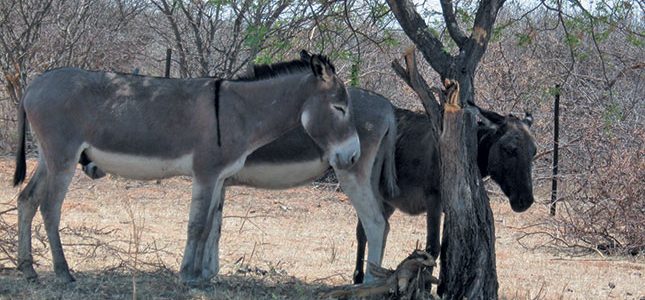
Donkeys put out of their misery in Zimbabwe

A total of 78 donkeys have been euthanised over a four month period at what would have been Zimbabwe’s first abattoir for these animals, after inspectors found that they were either ill or badly injured.

Officials of the Zimbabwe SPCA, Veterinarians for Animal Welfare Zimbabwe (VAWZ), and the Department of Livestock and Veterinary Services (DLVS), who inspected the animals at a feedlot in Bulawayo between October 2017 and January this year, had given authorisation for the animals to be put down.

READ Donkey farming: opportunity or threat?

Animal welfare officer at VAWZ, Mel Hood, said: “We conduct regular inspections at that place so any decision is based on what we see on the ground. Our only option was to put the animals down.”

The abattoir was supposed to start operating in October 2017 after Zimbabwean company, Battlefront Investments, had invested US$150 000 (R1,8 million) in establishing it. Further funds were invested in buying 200 donkeys from various parts of the country.

Battlefront Investments had plans to export donkey meat and hides to China where it is processed into ejiao, a popular traditional Chinese medicine.

However, Josphat Nyika, a director of DLVS, told Farmer’s Weekly that the donkey abattoir had not been approved. “An application for setting up such an investment has not come to my office. The law does not allow any abattoir to slaughter donkeys,” he said.

Malabo Report stresses need to manage climate change

The Malabo Declaration was signed in 2014 by 20 African leaders to ensure that agriculture remained high on the continent’s development agenda.

CARE International, the Graça Machel Trust, and the Food, Agriculture Natural Resources Policy Analysis Network (FANRPAN) welcomed the first Malabo Biennial Report.

According to Dr Tobias Takavarasha, CEO of FANRPAN, the timely release of the report was a demonstration of commitment by the member states and the African Union (AU) to increase investment in agriculture.

The objective of the Malabo report was to end hunger and halve poverty by 2025. Takavarasha said this called for a significant shift in the way agriculture has been handled across the continent.

Despite the threat of climate change, a significant number of AU member states continue to rely on dryland agriculture.

According to Michelle D Carter, deputy managing regional director of CARE International for Southern Africa, the future of agriculture depended on the management of climate change.

There was a need for national investments targeted at efforts that address the threat to food and nutrition security by the changing climate. It was therefore disappointing that only Mauritius was on track with the commitment to enhance resilience to climate variability.

“We are hopeful that governments will implement recommendations to improve adoption and uptake of climate-resilient agriculture by smallholder farmers, especially women,” she said.

Climate change threatened global food security, the eradication of poverty and sustainable development, according to the Food and Agriculture Organization of the United Nations (FAO).

Greenhouse-gas emissions from human activity and livestock were a significant driver of climate change, trapping heat in the earth’s atmosphere and triggering global warming.

Climate change had both direct and indirect effects on agricultural productivity, including changing rainfall patterns, drought, flooding and the geographical redistribution of pests and diseases.

The FAO was supporting countries to both mitigate and adapt to the effects of climate change through a wide range of research-based and practical programmes and projects, as an integral part of the 2030 agenda and the Sustainable Development Goals.